
The biggest digital marketing trends in 2026 are AI-powered marketing, evolving SEO, Answer Engine Optimization (AEO), Generative Engine Optimization (GEO), personalization, short-form video, performance marketing, marketing automation, first-party data, and conversion-focused lead generation. Businesses that connect these channels into one strategy rather than running them separately see stronger, more measurable growth.
Digital marketing in 2026 is defined by one shift above all others: search is becoming conversational, AI is shaping how people discover brands, and businesses are under more pressure than ever to prove that marketing spend actually generates revenue.
Having a website and posting occasionally on social media is no longer a strategy. A connected approach SEO, AI-assisted content, social media marketing, performance marketing, and conversion optimization is what separates businesses that grow online from those that just have a presence online.
This guide breaks down the trends that matter, why they matter, and how to act on them whether you’re a small business, a startup, or an established brand looking to scale.
Digital Marketing Trends 2026: At a Glance
| Trend | What It Means | Why It Matters | Best For |
| AI-powered marketing | Using AI to improve research, content, analysis and automation | Improves efficiency and personalization | Most businesses |
| Evolving SEO | Optimizing content for AI-influenced search experiences | Supports organic visibility | All businesses |
| AEO | Creating content that directly answers questions | Improves answer visibility | Content-led businesses |
| GEO | Building visibility across generative AI experiences | Supports AI-era brand discovery | Growing brands |
| Personalization | Creating relevant experiences for audiences | Improves engagement | E-commerce, B2B & B2C |
| Short-form video | Educational and entertaining video content | Builds awareness and engagement | B2C & consumer brands |
| Performance marketing | Measuring campaigns against business outcomes | Improves marketing efficiency | Growth-focused businesses |
| Automation | Automating repetitive marketing activities | Saves time, improves consistency | SMEs & larger teams |
| Conversion optimization | Improving the journey from visitor to customer | Turns traffic into revenue | Lead-generation businesses |
These trends work together. AI supports SEO research and campaign analysis; SEO and AEO feed AI-search visibility (GEO); and performance data tells you which of it all is actually working.
1. AI Is Becoming a Core Part of Digital Marketing
AI helps businesses research faster, personalize better, and automate repetitive marketing work but it works best paired with human strategy, not as a replacement for it.
AI can support keyword and topic research, customer segmentation, content ideation, search-intent analysis, competitor research, ad-creative variations, campaign analysis, lead qualification, and reporting.
The strongest approach combines AI’s speed at processing information with human expertise, creativity, and industry judgment. An agency might use AI to analyze hundreds of search queries and surface recurring customer questions but it still takes a strategist to turn those insights into an original content plan.
Google’s own guidance reinforces this: AI-assisted content should prioritize accuracy, relevance, and genuine value not high-volume publishing aimed purely at manipulating rankings.
2. SEO Is Evolving Alongside AI Search
SEO is still essential in 2026 there’s no separate “AI SEO” checklist. The same fundamentals (crawlability, helpful content, internal links, structured data, page experience) determine visibility in both classic search and AI-generated answers.
Search behavior is shifting toward longer, more conversational queries, and users increasingly see AI-generated summaries before traditional results. That doesn’t mean traditional SEO is obsolete it means content needs to be genuinely useful across more types of search experiences.
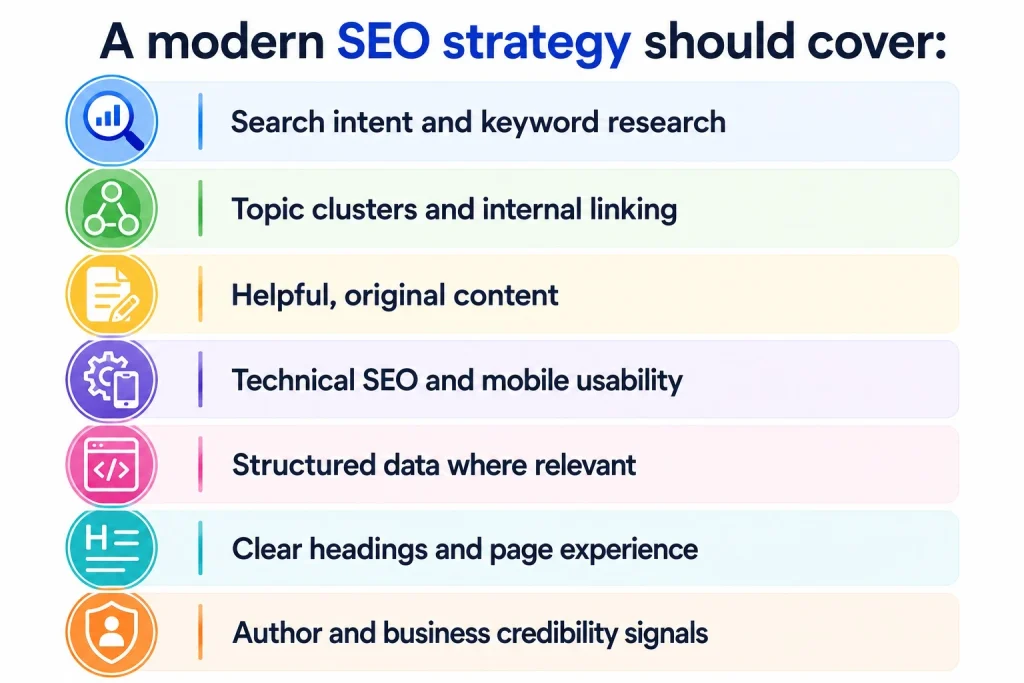
A modern SEO strategy should cover:
- Search intent and keyword research
- Topic clusters and internal linking
- Helpful, original content
- Technical SEO and mobile usability
- Structured data where relevant
- Clear headings and page experience
- Author and business credibility signals
Businesses building this foundation or auditing an existing one can start with a proper SEO services engagement that covers technical, on-page, and content SEO together rather than in isolation.
3. AEO Helps Businesses Answer Customer Questions Directly
Answer Engine Optimization (AEO) means structuring content so it directly and concisely answers the specific questions your customers are asking not just the keywords they type.
Traditional SEO targets queries like “digital marketing agency in Mumbai.” AEO also targets the conversational questions behind that search, like “What digital marketing strategy is best for a small business?”
A strong AEO approach includes:
- Direct, concise answers placed near the top of each section
- Question-based headings
- FAQ sections with clear, standalone answers
- Step-by-step explanations and comparison tables
- Accurate, consistent business information across the web
For example, a SaaS company selling accounting software could build a resource answering: What is accounting software? How does it help small businesses? What does it cost? Is cloud better than desktop? Each answer should stand alone because that’s how AI answer engines and featured snippets pull content.
4. GEO Is Expanding the Search Visibility Conversation
Generative Engine Optimization (GEO) is about improving how accurately and favorably a brand is represented inside AI-generated answers and it works alongside SEO, not instead of it.
Google has been explicit that the same fundamental SEO practices apply to its generative AI search features. GEO simply extends that work by focusing on authority and originality specifically for AI systems to draw from.
A GEO-focused strategy includes:
- Publishing original research and data-backed insights
- Building comprehensive, interconnected topic resources
- Strengthening internal linking and site structure
- Earning relevant third-party mentions and citations
- Demonstrating clear subject-matter expertise
The goal is to make a brand genuinely useful and citable not to “trick” AI systems, which don’t respond well to manipulation anyway.
5. Personalization Is Becoming Non-Negotiable
Personalization means tailoring content, offers, and messaging to where a customer actually is in their journey not treating every visitor like a first-time stranger.
Customers move across websites, search, social media, email, and ads generic messaging gets lost in that noise. Personalization can apply to website recommendations, email campaigns, landing pages, ad audiences, retargeting, and lead nurturing.
Someone who has already visited a service page should see a different follow-up than someone hitting the brand for the first time. The goal isn’t to personalize everything it’s to make the parts that matter more relevant.
6. Social Media Marketing Is Becoming More Content-Driven
Social media in 2026 works as a discovery and trust-building channel, not a broadcast channel content that teaches or demonstrates something outperforms pure promotional posts.
Effective formats include short-form video, tutorials, product demonstrations, customer stories, behind-the-scenes content, and user-generated content.
Instead of asking “what should we post today?” the better question is: “what does our audience need to know, understand, or solve?” Brands looking to turn social from a posting habit into an acquisition channel typically pair organic content with paid amplification the approach behind a structured social media marketing strategy.
7. Performance Marketing Is Moving Beyond Clicks
Performance marketing in 2026 is measured by revenue outcomes — cost per lead, customer acquisition cost, and ROAS not clicks or impressions alone.
A stronger measurement framework tracks the full funnel: Ad → Landing Page → Lead → Qualified Lead → Customer → Revenue.
A campaign generating 200 leads isn’t automatically better than one generating 80 — if the smaller campaign converts significantly more of those leads into paying customers, it’s the stronger investment. This is the core principle behind data-led performance marketing: optimizing for business outcomes, not vanity metrics.
8. Lead Generation Is Becoming More Strategic
Effective lead generation in 2026 is built around intent and measurable follow-through — not just traffic volume.
Common lead-generation mechanisms include consultation forms, free assessments, downloadable guides, webinars, and chat-based enquiries. But the mechanism matters less than the measurement that follows:
- Where did the lead come from?
- Was the lead qualified?
- Did the lead become a customer?
- How much revenue did that customer generate?
Answering these questions turns lead generation from a traffic activity into a measurable business process and it’s why content marketing built around real search intent tends to outperform generic blogging.
9. Customer Acquisition Needs Multiple Connected Channels
Customers rarely convert in one step most journeys move through awareness, discovery, research, consideration, conversion, and retention across several channels.
| Stage | Primary Channels |
| Awareness | Social media, video, advertising |
| Discovery | SEO, content, search-focused resources |
| Consideration | Case studies, comparisons, service pages |
| Conversion | Landing pages, offers, clear CTAs |
| Retention | Email, support, personalized follow-up |
Each stage requires different content, and an integrated approach ensures every channel supports the same growth objective instead of competing for budget in isolation.
10. Conversion Optimization Matters as Much as Traffic
More traffic doesn’t guarantee more revenue — conversion rate determines how much of that traffic actually becomes business.
Consider two businesses: one gets 50,000 visitors on a poorly designed site; another gets 10,000 highly relevant visitors on a well-optimized journey. The second business often generates more enquiries.
Key areas to review: landing pages, calls to action, contact forms, page speed, mobile experience, navigation, and trust signals. Businesses investing in traffic without reviewing these fundamentals are typically leaving revenue on the table.
11. Marketing Automation Helps Businesses Scale
Automation frees up marketing teams from repetitive tasks – but it should support strategy, not replace it.
Automation works well for email follow-ups, lead nurturing, segmentation, lead scoring, and retargeting particularly for small and growing teams with limited resources. A poorly designed automated campaign, though, just distributes irrelevant messages faster. The best systems pair automation with real segmentation and human oversight.
12. First-Party Data Will Become More Valuable
As reliance on third-party platforms decreases, the businesses that win are the ones that understand their own customers directly.
First-party data website interactions, purchases, CRM data, customer feedback — should always be collected with proper privacy and consent practices. Used responsibly, it helps businesses identify which services generate the highest-quality leads and where to allocate resources.
How Should Small Businesses Adapt Their Strategy in 2026?
Small businesses don’t need every new marketing technology they need the fundamentals done well:
- Build a strong website that clearly explains what you offer and why customers should choose you.
- Establish an SEO foundation around valuable commercial and informational searches.
- Build topical authority with interconnected content, not random blog posts.
- Answer real customer questions clearly and with genuine expertise.
- Use social media strategically, focusing on platforms your audience actually uses.
- Test paid advertising with controlled budgets, measuring qualified leads over vanity metrics.
- Improve conversion rates before scaling traffic spend.
- Measure business outcomes leads, customers, acquisition cost, and revenue.
This is the same structured approach Quants Media uses when building strategy for clients you can see the methodology in action across our case studies.
What Is the Best Digital Marketing Strategy for Startups?
Startups should prioritize finding one repeatable acquisition channel before expanding into multiple platforms.
A typical sequence looks like: Audience Research → Website → SEO/Content → Social Media → Paid Testing → Conversion Optimization → Analytics.
A B2B startup often gets more value from LinkedIn content, SEO, and thought leadership than from consumer-focused platforms. A consumer brand often benefits more from social content, creators, and conversion-focused landing pages. The right mix depends on customer behavior not whatever channel is trending.
What Will Digital Marketing Look Like in the Future?
The future isn’t about choosing between SEO, AI, social media, or advertising it’s about connecting them. Search engines and AI systems will keep evolving, but the underlying principle stays the same: useful businesses with useful information are easier for customers to discover, understand, and trust.
Frequently Asked Questions About Digital Marketing Trends 2026
What are the top digital marketing trends in 2026?
The major trends include AI-powered marketing, evolving SEO, AEO, GEO, personalization, short-form video, performance marketing, automation, first-party data, and conversion-focused lead generation.
Is SEO still important in 2026?
Yes. AI-powered search experiences still rely on underlying search systems and indexed web content, and Google has confirmed its core SEO fundamentals continue to apply to AI Overviews and AI Mode.
How is AI changing digital marketing?
AI supports research, customer analysis, content workflows, personalization, and reporting but businesses still need human expertise and quality control to use it effectively.
What is AEO in digital marketing?
AEO (Answer Engine Optimization) structures content so it clearly and directly answers user questions, making it easier for answer-oriented search experiences to surface.
What is GEO in digital marketing?
GEO (Generative Engine Optimization) focuses on improving a brand’s visibility and accuracy of representation inside generative AI-powered discovery experiences, complementing rather than replacing SEO.
How can small businesses use digital marketing in 2026?
By starting with a strong website, SEO foundation, useful content, focused social media presence, and conversion optimization prioritized based on their specific customers and goals.
How can digital marketing help increase sales?
By attracting relevant audiences, building trust, generating qualified leads, nurturing prospects, and improving conversion rates across the full customer journey.
How much does digital marketing cost for a business?
Costs vary by business goals, industry, competition, geography, and the number of channels involved — there’s no universal price.
How Quants Media Can Help Businesses Grow Online
Keeping up with trends only matters if they translate into results. Quants Media builds integrated strategies across SEO, AEO and AI-search visibility, content marketing, social media marketing, performance marketing, and conversion optimization — connected to one growth objective instead of run as separate campaigns.
See how this approach has worked for other brands in our case studies, or get in touch to talk through a strategy built around your business, audience, and budget.
Final Thoughts
Digital marketing in 2026 is becoming more integrated, more intelligent, and more accountable to revenue. AI is changing how marketers work, search is becoming conversational, and AEO and GEO are opening new visibility conversations — but the fundamentals haven’t changed: build a solid digital foundation, understand customer intent, create genuinely useful content, and measure what actually matters to the business.
Businesses that combine SEO, AI, content, social media, paid advertising, and conversion optimization into one connected strategy — instead of chasing every new trend individually — will be the ones that turn visibility into growth.
Explore more strategy breakdowns on the Quants Media blog, or read about our approach on the About Us page.