
Backlinks are still one of the clearest signals of trust on the web, and SEO teams now use AI for almost every stage of link building, from prospecting to outreach. But the same technology that speeds up research also makes it easy to flood the web with low-quality links.
So the useful question isn’t “Can AI build backlinks?” It’s “Does this link deserve to exist?” A link from a relevant, credible site is valuable whether a human or an AI tool found the opportunity. A link created only to manipulate rankings is a risk either way, and Google’s spam policies are clear that automated link creation and link schemes fall into that category.
The approach that works: use AI as a research assistant, not a backlink factory.
What Do “AI-Generated Backlinks” Actually Mean?
The term covers two very different practices, and mixing them up is where most confusion starts.
AI-assisted link building uses AI for the slow, repetitive parts of the job: finding relevant websites, studying competitors’ links, sorting prospects and drafting outreach. A person still reviews every opportunity and makes the final call.
Automated backlink generation uses software to create links in bulk, often through low-quality directories, blog comments, spun articles, link networks or pages that exist only to hold links. Volume is the goal, and relevance is an afterthought.
| AI-assisted link building | Automated AI backlinks | |
|---|---|---|
| Role of AI | Researches and organizes prospects | Produces links at scale |
| Human involvement | Reviews every opportunity | Little or none |
| Priority | Relevance and quality | Quantity |
| Outreach | Personalized and edited | Mass-generated |
| Content purpose | Helps readers | Exists to host links |
| Long-term effect | Builds authority and relationships | Creates unnatural patterns |
For most businesses, the first approach is the only sustainable one.
Do AI-Generated Backlinks Improve Rankings?
They can contribute, but no single backlink guarantees a ranking improvement, and more links don’t automatically mean better results.
Picture two sites. Website A buys 100 automated links from unrelated, low-quality pages, all using the same keyword-heavy anchor text. Website B earns 10 links from credible sites in its niche, each placed naturally inside genuinely useful content. Website B almost certainly has the healthier backlink profile, and the stronger foundation for ranking, despite having a tenth of the links.
That’s the principle behind modern link building: a few relevant, earned links outweigh a pile of manufactured ones.
What Makes a Backlink High Quality?
The same standards apply whether a link was found manually or with AI.
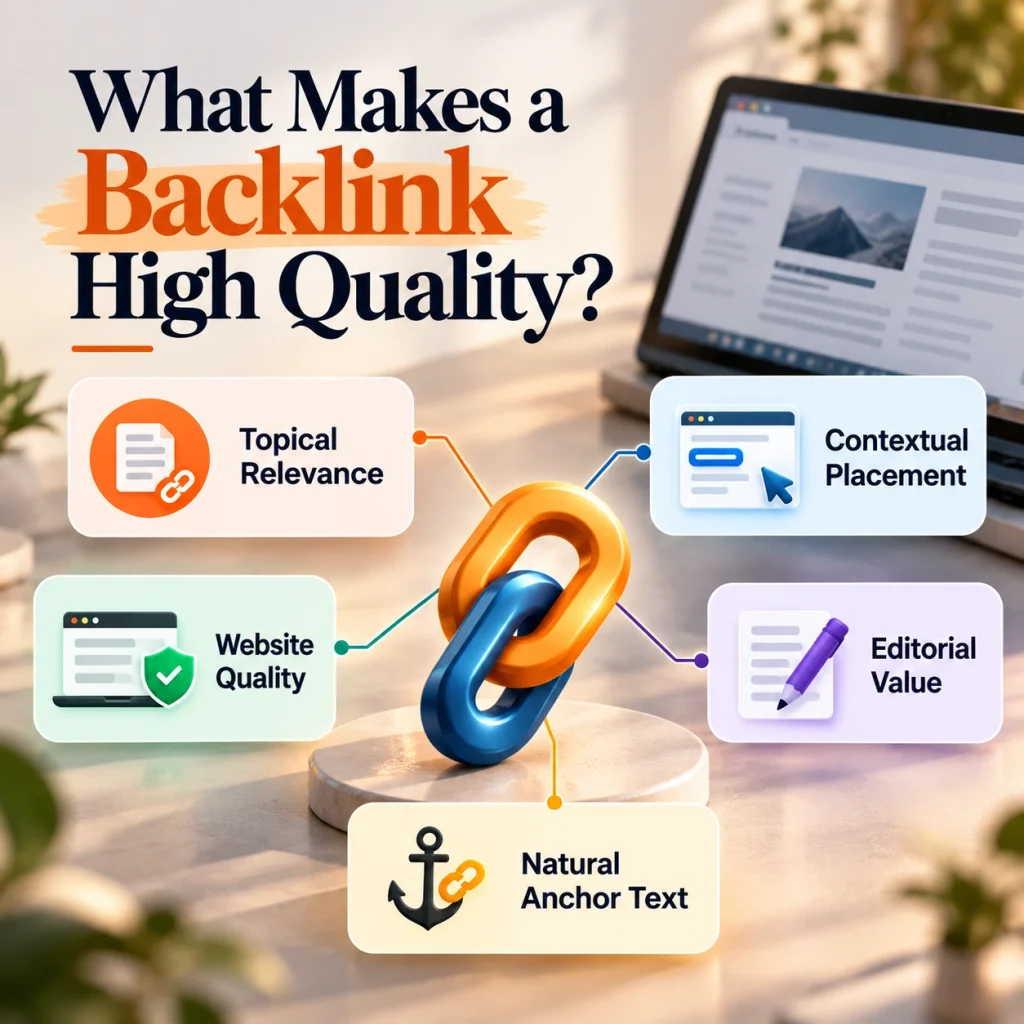
Topical relevance. Would this site mention you even if SEO didn’t exist? A cybersecurity firm cited by a tech publication makes sense. The same firm collecting links from recipe blogs and car-accessory sites does not.
Natural context. The link should sit inside content where it helps the reader, not be dropped into an unrelated paragraph.
Real website quality. Don’t rely on Domain Authority or similar third-party scores alone. Open the site. Is it maintained? Does it publish useful content, have a clear focus and an actual audience, and show organic visibility?
Editorial value. A good link has a reason to exist: original research, unique data, expert commentary, a useful tool, a strong case study or a comprehensive guide. If nobody has a reason to cite your content, an AI-written article built just to hold a link won’t fix that.
Natural anchor text. Healthy profiles mix brand names, bare URLs, descriptive phrases and partial matches. Forcing the same commercial keyword into every link is a pattern that looks manufactured.
Are AI-Generated Backlinks Safe?
It depends entirely on the method. Using AI to analyze backlink data or prepare outreach is low risk. Using it to create thousands of links is not.
Watch for these warning signs:
- Mass automated link creation
- Irrelevant or low-quality directories
- Sites that exist mainly to sell or host links
- Large-scale link exchanges
- Keyword-stuffed anchor text
- Guest-post networks that accept anything
- Auto-generated comments with links
- The same article republished across many sites
- Sudden spikes of links with no obvious reason
A good rule to remember: automate research, not judgment.
Where AI Genuinely Helps With Link Building
Used well, AI saves hours of manual work without touching the part that needs human judgment.
Prospecting. AI can sort a large list of potential sites into categories such as industry publications, news sites, resource pages, associations, local organizations and expert communities. You then review the shortlist by hand.
Competitor analysis. AI can organize competitor backlink data and surface patterns. If two competitors were both cited by the same publication, one for a research report and one for a statistics page, you’ve found a gap. The goal isn’t to copy their link. Ask why they earned it and whether you can create something more useful.
Link gap analysis. Compare your profile with competitors’ to find sites that link to them but not you, topics that attract links in your industry, and resource pages worth targeting.
Outreach. AI can draft emails using the publication’s topics, the recipient’s role and a relevant article they’ve written. A person should always edit the result. Swapping a name into the same pitch and sending it to 5,000 sites isn’t personalization.
A Practical Workflow: AI-Assisted Link Building in 7 Steps
- Define the goal. Skip “How do I get 1,000 backlinks?” and ask “Which sites should know about our business or content?” Your goal might be brand visibility, industry mentions, promoting research or referral traffic.
- Find prospects. Use AI to surface sites by industry, audience and topic, then review them manually.
- Evaluate each site. Check relevance, content quality, reputation, audience, editorial standards and existing outbound links. A high AI score is not a reason to accept a prospect.
- Create something worth linking to. Original research, industry reports, calculators, expert interviews or detailed case studies give publishers a real reason to cite you. This is where strong content marketing pays off, because link-worthy assets are what make outreach work.
- Personalize outreach. Let AI draft, then edit. Reference something specific about the site or article.
- Earn the placement. Aim for a legitimate editorial mention, not a link inserted wherever it fits.
- Monitor your profile. Track new referring domains, sudden spikes, irrelevant sources, repeated anchor text and lost links, so you catch unusual patterns early.
AI-Generated Content and AI-Generated Backlinks
The two are closely linked. A company could use AI to produce hundreds of articles, publish them across multiple sites and point links back to its own domain. It looks efficient, but if the purpose is to manipulate rankings rather than help people, it’s a quality problem.
Google’s guidance on creating helpful, people-first content stresses that content should exist to serve readers, not just attract search traffic. Its position on AI-generated content is that AI use isn’t automatically a problem. What matters is the purpose, quality and value of what’s published.
- Better path: AI research → human expertise → original insight → useful content → legitimate promotion → earned links
- Riskier path: AI generation → mass publishing → automated links → ranking manipulation
The first creates an asset. The second just creates volume.
Common Mistakes to Avoid
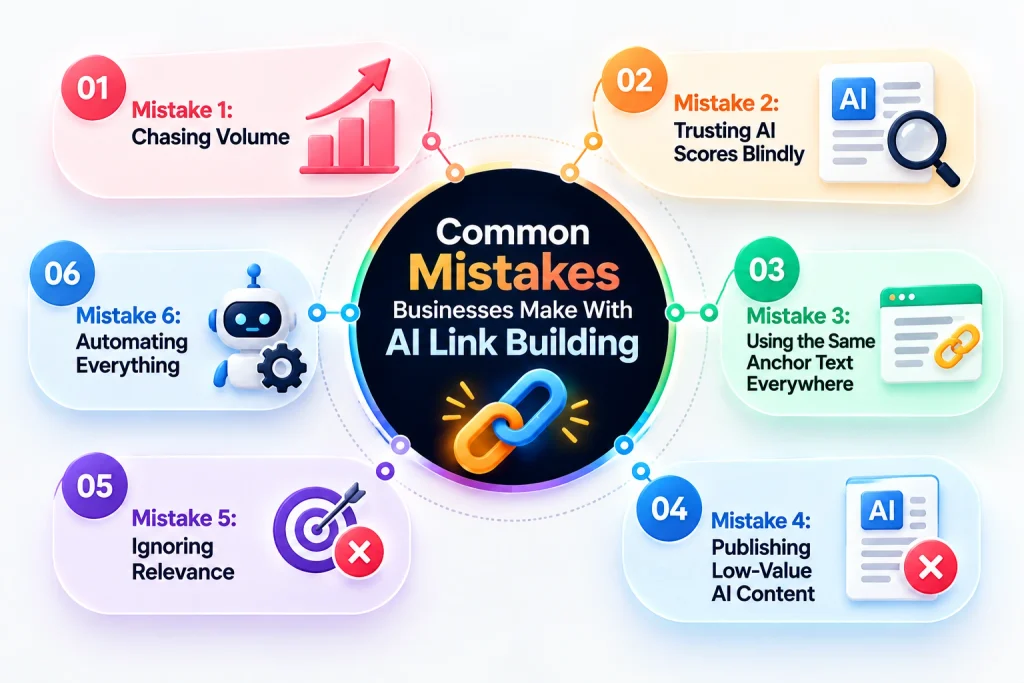
- Chasing volume. Twenty relevant editorial links are worth more than hundreds of irrelevant ones.
- Trusting AI scores blindly. Tools help prioritize, but you should always visit the site yourself.
- Repeating the same anchor text. Vary it, and write it like natural language.
- Publishing low-value AI content just to have somewhere to put a link.
- Ignoring relevance because a domain has a strong third-party metric.
- Automating everything. Automation suits repetitive tasks, not strategy.
Where Backlinks Fit in a Wider SEO Strategy
Links don’t work in isolation. A strong strategy combines technical SEO, on-page optimization, content, keyword research, internal linking, digital PR, link building and conversion optimization, all measured against real business goals.
That matters because a great backlink to a weak page wastes its potential. If the destination loads slowly or doesn’t match search intent, visitors leave and the link’s value shrinks. Fixing page experience, including Core Web Vitals, and having a fast, well-built website to send visitors to are part of making link building pay off.
If you want to see how this fits into the bigger picture, our look at digital marketing trends in 2026 covers where search and online marketing are heading.
Frequently Asked Questions
Are AI-generated backlinks good for SEO?
They can be, when they come from relevant, credible sites and add real value. Whether AI was involved doesn’t determine a link’s quality. Relevance, context and editorial merit do.
Can AI backlinks improve Google rankings?
They can contribute to overall SEO performance when they’re legitimate and valuable. No individual link guarantees a ranking boost, and creating links in bulk doesn’t guarantee better results.
Is AI link building safe?
AI-assisted link building is generally sustainable when AI handles research and analysis and people review each opportunity. Automated link generation aimed at manipulating rankings carries much higher risk.
Does Google penalize AI-generated backlinks?
Google’s policies target manipulative practices, not AI use itself. Automated link creation and link schemes designed to manipulate rankings can violate its spam policies.
What makes an AI-found backlink high quality?
Topical relevance, useful context, a credible source, editorial value, natural anchor text and a genuine reason for the site to reference you.
Can AI find quality link opportunities?
Yes. It can identify prospects, analyze competitor links, run gap research, categorize sites and help with outreach. Human review is still essential.
Should businesses automate backlink creation?
Be cautious. Automation is best for research, data organization and repetitive tasks, not for mass-producing links.
How many backlinks do I need to rank?
There’s no universal number. Query competitiveness, competing pages, content quality, search intent and overall site authority all play a part.
Are backlinks still important for SEO?
Yes, as one part of a broader strategy. Relevant, useful references support authority and discoverability, but low-quality link volume can’t replace strong content and technical SEO.
Final Takeaway: Make Link Building Smarter, Not Spammier
AI-generated backlinks can improve rankings, but not because AI generated them. The value comes from the relevance of the site, the context of the link, the editorial reason for the mention and the usefulness to the reader.
The winning formula isn’t “generate more links.” It’s: find better opportunities → create better resources → personalize outreach → earn legitimate mentions → monitor quality.
At Quants Media, we build link building into a wider SEO strategy that combines technical optimization, on-page work, content and authority building. The aim isn’t to chase backlink numbers. It’s to build a stronger, more relevant online presence over time.
Want to use AI for link building without the risk? Talk to our team and we’ll help you build a strategy that earns links worth having.